
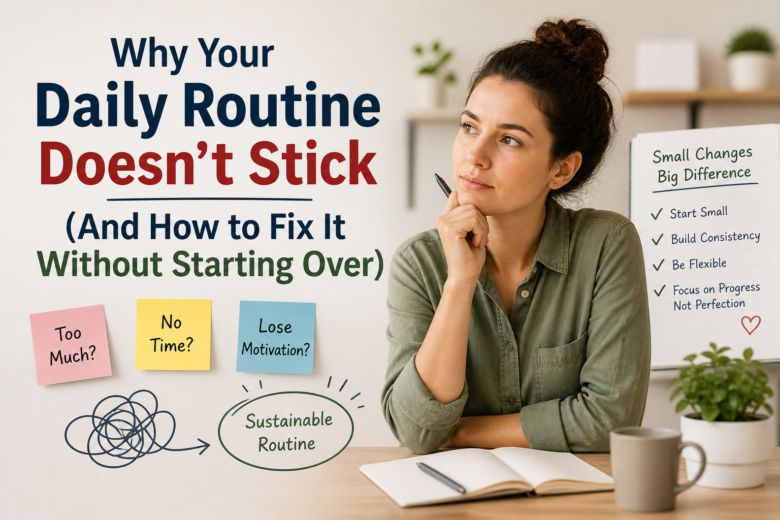
For many people, developing a good habit isn’t difficult.
The challenge lies in sticking with it.
You’ve likely experienced this scenario before: you create a well-thought-out plan with clear goals, and perhaps you even stick to it for a few days. But then, everything changes. A busy day, low energy, or even a minor distraction can disrupt your plan. At that point, it becomes difficult to get back on track.
This is normal, but it doesn’t necessarily mean you lack self-discipline. Usually, it indicates that your plan isn’t effective in practice.
A better approach is to understand which habits tend to fail and how to develop a habit that sustains itself—even when you encounter difficulties—rather than having to start completely over each time.
The Hidden Problem: Habits That Only Work When Everything Is Perfect
Most habits are formed when you are calm and motivated.
You schedule them when you are focused, organised, and motivated to improve. However, daily life isn’t always like that. Energy levels fluctuate, schedules change, and unexpected tasks come your way.
If your plan only works when everything is perfect, it will fail in the long run.
A sustainable daily habit must be effective in all three of these situations:
- High-energy days
- Ordinary days
- Low-energy days or days with a busy schedule
If it only works in one of these situations, its consistency is questionable.
What Really Causes a Habit to Break?
There are many reasons why habits fail.
1. Making Too Many Changes at Once
Introducing multiple habits simultaneously causes them to compete for your attention. This increases your mental load and undermines consistency.
2. A Rigid Structure
A rigid schedule may seem efficient, but it offers little flexibility. Even a minor change can throw the entire plan into disarray.
3. Overestimating Time and Energy
People easily overestimate their available time and energy. This leads to plans that are difficult to sustain.
4. Lack of Rest
Without short breaks and adjustments, daily habits eventually become monotonous.
5. Black-and-White Thinking
If you skip a step in your daily routine—which might lead to an irregular sleep pattern, for instance—you tend to neglect your entire schedule.
Understanding these patterns can help you avoid similar situations in the future.
A Better Approach: Creating a Flexible Core Routine
Instead of trying to create a perfect daily routine, it is better to build a simple and flexible core routine.
This core routine should contain only the most essential elements—those that are beneficial to your daily life but do not require excessive effort.
Think of it as your “minimum”:
- Things you can do even on busy days.
- Things you can do without needing motivation.
- Things you feel confident you can accomplish.
For example, your core routine might consist of:
- Drinking a little extra water
- Taking a walk for a few minutes
- Scheduling a break during the day
Everything else is optional, not mandatory.
Expanding Without Pressure
As you become more comfortable with your core routine, you can gradually add more substance to it.
Instead of adding extra fixed tasks, consider adding layers.
Core Layer → Essential tasks (simple, daily)
Optional Layer → Tasks to do when time/energy is available
Extended Layer → Deeper daily habits to do when you have high energy
This layered approach offers both flexibility and structure.
If you have low energy, complete the core layer.
Having high energy means you will naturally contribute more to it.
The Role of Environment in Habit Formation
The environment is one of the most easily overlooked factors when developing habits.
The environment can be favourable or unfavourable.
For example:
- If healthy alternatives are available, better choices will naturally emerge.
- If your workspace is tidy, your focus will naturally be sharper.
- If distractions are kept to a minimum, forming daily habits becomes easier.
Don’t rely solely on self-discipline. Change your environment to make habit formation easier.
Simplify and Restart
One of the most effective ways to improve is by removing the pressure of ‘starting over.’
Most habits don’t fail because they break down but because people find it difficult to pick them back up after a pause.
To address this issue:
- Keep your core habits simple.
- Don’t punish yourself for missed days.
- Focus on the next small step.
A habit that is easy to resume is more sustainable than a habit that demands perfection.
Recognizing Natural Fluctuations
Your days don’t have to be monotonous.
Some days fly by; others drag on. That is normal.
Don’t try to be perfect all the time. Try to focus on the present.
Even brief moments of companionship can help you stick to your habits.
Practical Example of a Flexible Routine
Instead of creating a rigid schedule, consider using flexible time blocks:
Morning:
- Ease into the day (have a drink and engage in some simple activities)
- No need to rush through lengthy daily routines
Daytime:
- Take short breaks to maintain focus
- Keep your schedule for meals and activities simple
Evening:
- Gradually wind down
- Tips for Easily Preparing for a Break
Each module can be adapted to suit your energy levels and available time.
Changing Your Perspective on Progress
People often mistakenly believe that making progress means doing *more*.
In reality, progress in daily life means doing things *consistently*—no matter how small.
Don’t ask yourself:
“Did I achieve everything?”
Instead, ask yourself:
“Did I stick to my basic plan?”
This reduces stress and helps you maintain consistency over the long term.
When You Need to Adjust Your Daily Routine
Daily routines should evolve gradually.
Adjustments may be necessary in the following situations:
- Your schedule changes
- Your workload increases
- Your energy patterns shift
- Adjustments are normal and necessary.
Don’t try to rebuild everything from scratch. Instead, refine what is already working.
Recurring Mistakes
Rebuilding your routine from scratch every time it gets disrupted:
- Introducing too much complexity too soon
- Pushing past your personal boundaries
- Expecting the same results every single day
- Comparing your daily habits to those of others
Avoid falling into these habits, and you will maintain stability.
Conclusion
The habits that truly last are not the ones that seem impressive but the ones that adapt to change.
Don’t start over completely every time circumstances shift; instead, focus on building a flexible framework that can stand the test of time. When your daily routine becomes something you can easily return to, consistency comes almost naturally.
You don’t need a perfect system.
What you need is a system that works—even when life gets tough.
Frequently Asked Questions
1. Why do I struggle to stick to my daily routine?
Most daily routines fail because they are too difficult or impractical. A simple, flexible plan is easier to sustain.
2. Do I have to follow the same routine every day?
Not necessarily. Your plan should be tailored to your energy levels and your daily schedule.
3. If I break my routine, how do I get back on track?
Don’t try to fix everything at once; focus on just one small change. Starting over doesn’t have to be daunting—it can actually be easy.
4. Is it okay to have a few days where I don’t feel like making an effort?
Yes. Taking the occasional break is an essential part of a sustainable daily routine. It provides structure without burning you out.
5. What is the most important element of a daily routine?
Consistency. It is better to perform simple daily activities every day than to perform complex activities only occasionally.

Ayaan Zahid writes about practical wellness with a focus on balance, consistency, and everyday habits. He believes health advice should be simple, realistic, and easy to apply without pressure. His content is created for general informational purposes only and does not replace professional medical advice. Through HistoryFlare, he shares clear, approachable insights to help readers improve energy, mindset, and overall well-being in a sustainable way.